

By providing your phone number and opting in for messages, you are consenting to receive sms/mms msgs based on your selection, including texts, to that number from Protect Prosperity or Americans for Prosperity. Msg&data rates may apply. Additionally, users may receive calls, including autodialed and automated calls from Protect Prosperity or Americans for Prosperity. Terms & conditions/privacy policy apply.

How lawmakers can empower small businesses

Small businesses don’t need special treatment.
They need the freedom to grow, hire workers, and invest in their communities without being buried under high taxes, bloated regulations, and economic uncertainty.
That’s why long-term tax certainty is so important.
A key feature of the Working Families Tax Cuts is its permanent tax relief for individuals and small businesses. By removing expiration dates from major tax cuts, the law gives entrepreneurs more confidence to plan ahead and invest for the future.
For many owners, that certainty can make the difference between standing still and taking the next step.
Small businesses need stability, not more barriers

Vicki Harry, owner of Thanks A Latte, knows exactly what stability feels like, thanks to the Working Families Tax Cuts.
“This year I’m doing something big,” Vicki shared. “I’m building a brand new store.”
Because of the bill, Vicki says she’ll be able to fully write off the cost of new equipment this year. That includes shelving, registers, coffee equipment, and kitchen supplies.
“It all counts,” she said. “That means I can invest now without being buried in debt later.”
That kind of relief is crucial for small business owners already dealing with rising costs and government hurdles that make expansion more difficult.
High taxes reduce the money businesses can reinvest. Complicated regulations and permitting delays slow projects and add costs that many small businesses can’t easily absorb.
When taxes constantly change or temporary policies are set to expire, owners often delay hiring, expansion, or equipment purchases altogether. All of this means less investment in their communities.
As Nate, a small business owner from Ohio, put it, “Every dollar matters when we were staring down high taxes. It wasn’t just numbers on paper. It was fewer hours for my team.”
“That’s real savings … for people like me.”
The law also permanently extended a 20% tax deduction for many small businesses with pass-through income, where profits are taxed on the owner’s personal return rather than at the corporate level.
Vicki’s message is simple: “We don’t want handouts. We just want a fair shot.”
Because when small businesses have confidence in the future, they’re more likely to:
- Hire workers
- Buy equipment
- Expand operations
- Invest locally
Small businesses drive local economies
Small businesses play a major role in communities across the country.
According to the U.S. Chamber of Commerce, small businesses employ nearly half of the American workforce. They also account for roughly 43% of America’s gross domestic product.
They create jobs, support local events, and keep investment close to home.
But many owners say growing a business has become harder because of rising costs, burdensome regulations, and unnecessary red tape.
That was the focus of Americans for Prosperity–Michigan’s “Standing Up for Small Business” panel in Plainwell, Michigan, featuring former U.S. Rep. Mike Rogers, local business owners, and AFP–Michigan State Director Tim Golding.
In the western part of the state, the event brought together entrepreneurs to discuss the challenges they face and the policies that could help create more opportunity across Michigan.
You can see Rogers and Golding engaging with the crowd below:
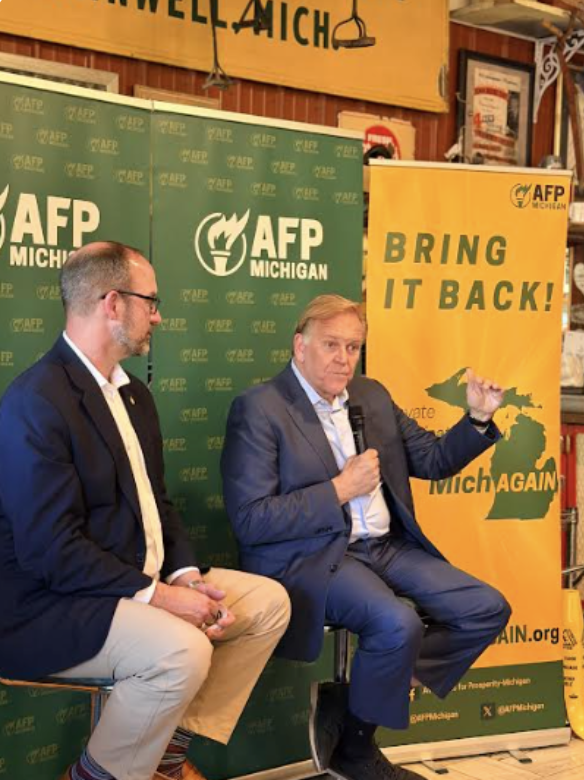
“Michigan’s small businesses are ready to grow, hire, and invest in their communities,” Golding said. “If we want Michigan to compete and win, we need leaders who are willing to modernize outdated regulations and create a business climate that rewards innovation and hard work.”
That conversation resonated with the business owners at the panel, who know too well the difficulties of running or starting a small business.
The emphasis was clear: When local businesses struggle, communities feel it too.
Strong communities start local
Strong communities are built by people willing to take risks, create jobs, and invest in their neighbors.
Lawmakers can help by creating policies that reward hard work, lower barriers, and reduce uncertainty instead of making it harder to do business.
But you have a role to play, too.
You can start by shopping small and supporting local businesses. This helps keep opportunity rooted close to home. Whether it’s grabbing coffee from a neighborhood café or supporting a family-owned restaurant, those small steps make a real difference.
The bottom line:
Small businesses don’t just power local economies.
They help hold communities together.
And when business owners have the freedom and confidence to invest in the future, everyone benefits.
To hear directly from small business owners like Vicki about how policies like the Working Families Tax Cuts are affecting their businesses, click here.
You can also take a moment to sign our letter thanking the lawmakers who proudly supported the Working Families Tax Cuts, which encouraged small business owners to pursue their American Dream.